Genetic-disorders-intel-oneAPI-CodeMaven
🌟Submission for Intel OneAPI CodeMaven by TechGig 🌟
Video
Medium Blog
Problem 3: Healthcare for underserved communities
-
The theme for this open innovation hackathon is using technology to improve access to healthcare for underserved communities.
-
This theme is focused on addressing the disparities and challenges that many communities face in accessing quality healthcare services.
-
While healthcare is a basic human right, many people are unable to access it due to various factors such as financial barriers, geographic location, language barriers, and limited healthcare resources.
-
The goal of this hackathon is to bring together software developers to develop innovative solutions that can help to overcome these barriers and improve access to healthcare for underserved communities.
-
The theme is focused on leveraging technology to create solutions that can be easily scalable, affordable, and accessible to everyone, regardless of their background or circumstances. - The solutions developed through this hackathon can have a significant impact on improving healthcare outcomes and quality of life for underserved communities.
Research around the Idea
- Genetic disorders are the result of mutation in the deoxyribonucleic acid (DNA) sequence which can be developed or inherited from parents.
- Such mutations may lead to fatal diseases such as Alzheimer’s, cancer, Hemochromatosis, etc. Recently, the use of artificial intelligence-based methods has shown superb success in the prediction and prognosis of different diseases.
- The potential of such methods can be utilized to predict genetic disorders at an early stage using the genome data for timely treatment.
- This study focuses on the multi-label multi-class problem and makes two major contributions to genetic disorder prediction.
- A novel feature engineering approach is proposed where the class probabilities from an extra tree (ET) and random forest (RF) are joined to make a feature set for model training.
- Secondly, the study utilizes the classifier chain approach where multiple classifiers are joined in a chain and the predictions from all the preceding classifiers are used by the conceding classifiers to make the final prediction.
- Because of the multi-label multi-class data, macro accuracy, Hamming loss, and α-evaluation score are used to evaluate the performance.
- Results suggest that extreme gradient boosting (XGB) produces the best scores with a 92% α-evaluation score and a 84% macro accuracy score.
- The performance of XGB is much better than state-of-the-art approaches, in terms of both performance and computational complexity.
Instructions to run it
-
Download my code from GitHub in
Zip File -
Extractthe downloaded file -
Download the current version of
Python -
Install
Jupyter Notebook -
In the file's command terminal type
jupyter notebook -
You will be redirected to
Jupyter notebook home page (localhost) -
You can see a file names as
Predict genetic disorder.ipynbin the Jupyter notebook page -
Open the
file -
The file will run in
localhostin Jupter Notebook -
You can see the output of the code in the localhost
Optimizations
-
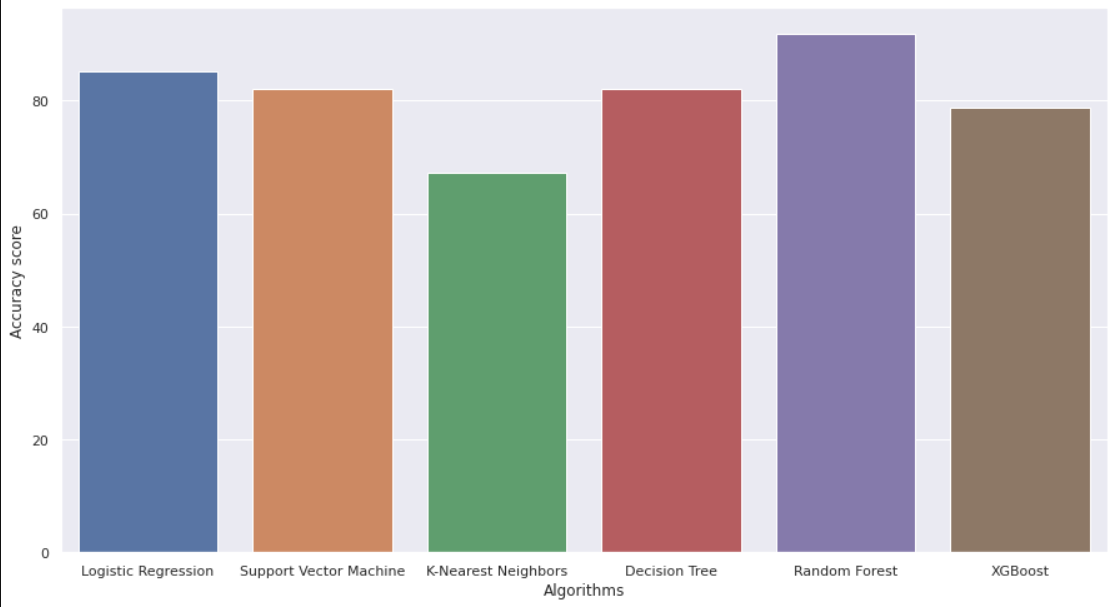
SVM --> 79.54 %
-
Logistic Regression --> 82.59 %
-
RF --> 88.345 %
-
XGBoost --> 75.45 %
Performance Evaluation
-
Multi-label multi-class data
-
Macro accuracy
-
Hamming loss
-
α-evaluation score
Libraries Used
-
Intel oneDAL
Building application using intel oneDAL:
- The Intel oneAPI Data Analytics Library (oneDAL) contributes to the acceleration of big data analysis by providing highly optimised algorithmic building blocks for all phases of data analytics (preprocessing, transformation, analysis, modelling, validation, and decision making) in batch, online, and distributed processing modes of computation.
- The library optimizes data ingestion along with algorithmic computation to increase throughput and scalability.
Understanding of the data:
- I learned how to preprocess and clean the data, as well as how to handle missing values and categorical variables.
- I also have conducted exploratory data analysis to gain insights into the relationships between the variables.
Selection of appropriate algorithms:
- Learned how to select appropriate machine learning algorithms for the given problem.
- For example, logistic regression may be useful for binary classification problems, while decision trees may be better suited for multiclass problems.
Machine Learning:
- Learned about different machine learning algorithms and how they can be applied to predict cardiovascular disease and make recommendations for patients.
Data Analysis:
- I developed my experience in collecting and analyzing large amounts of data, including historical data, to train our machine learning models.
Comparison of model performance:
- I got experience with, how to compare the performance of different models using appropriate statistical tests or visualizations.
- This can help you choose the best model for the given problem.
Collaboration:
- Building a project like this likely required collaboration with a team of experts in various fields, such as medical science, machine learning, and data analysis, and I learned the importance of working together to achieve common goals.
Screenshots
Feedback
If you have any feedback, please reach out to me at madhumithasri333@gmail.com
