<!-- header start --> <div style="width: 100%;"> <img src="https://i.imgur.com/EBdldam.jpg" alt="TheBlokeAI" style="width: 100%; min-width: 400px; display: block; margin: auto;"> </div> <div style="display: flex; justify-content: space-between; width: 100%;"> <div style="display: flex; flex-direction: column; align-items: flex-start;"> <p><a href="https://discord.gg/theblokeai">Chat & support: my new Discord server</a></p> </div> <div style="display: flex; flex-direction: column; align-items: flex-end;"> <p><a href="https://www.patreon.com/TheBlokeAI">Want to contribute? TheBloke's Patreon page</a></p> </div> </div> <!-- header end -->
H2O's H2OGPT Research OASST1 LLaMa 65B GGML
These files are GGML format model files for H2O's H2OGPT Research OASST1 LLaMa 65B.
GGML files are for CPU + GPU inference using llama.cpp and libraries and UIs which support this format, such as:
Repositories available
- 4-bit GPTQ models for GPU inference
- 2, 3, 4, 5, 6 and 8-bit GGML models for CPU+GPU inference
- Unquantised fp16 model in pytorch format, for GPU inference and for further conversions
Prompt template
<human>: prompt
<bot>:
<!-- compatibility_ggml start -->
Compatibility
Original llama.cpp quant methods: q4_0, q4_1, q5_0, q5_1, q8_0
I have quantized these 'original' quantisation methods using an older version of llama.cpp so that they remain compatible with llama.cpp as of May 19th, commit 2d5db48.
These are guaranteed to be compatbile with any UIs, tools and libraries released since late May.
New k-quant methods: q2_K, q3_K_S, q3_K_M, q3_K_L, q4_K_S, q4_K_M, q5_K_S, q6_K
These new quantisation methods are compatible with llama.cpp as of June 6th, commit 2d43387.
They are now also compatible with recent releases of text-generation-webui, KoboldCpp, llama-cpp-python and ctransformers. Other tools and libraries may or may not be compatible - check their documentation if in doubt.
Explanation of the new k-quant methods
The new methods available are:
- GGML_TYPE_Q2_K - "type-1" 2-bit quantization in super-blocks containing 16 blocks, each block having 16 weight. Block scales and mins are quantized with 4 bits. This ends up effectively using 2.5625 bits per weight (bpw)
- GGML_TYPE_Q3_K - "type-0" 3-bit quantization in super-blocks containing 16 blocks, each block having 16 weights. Scales are quantized with 6 bits. This end up using 3.4375 bpw.
- GGML_TYPE_Q4_K - "type-1" 4-bit quantization in super-blocks containing 8 blocks, each block having 32 weights. Scales and mins are quantized with 6 bits. This ends up using 4.5 bpw.
- GGML_TYPE_Q5_K - "type-1" 5-bit quantization. Same super-block structure as GGML_TYPE_Q4_K resulting in 5.5 bpw
- GGML_TYPE_Q6_K - "type-0" 6-bit quantization. Super-blocks with 16 blocks, each block having 16 weights. Scales are quantized with 8 bits. This ends up using 6.5625 bpw
- GGML_TYPE_Q8_K - "type-0" 8-bit quantization. Only used for quantizing intermediate results. The difference to the existing Q8_0 is that the block size is 256. All 2-6 bit dot products are implemented for this quantization type.
Refer to the Provided Files table below to see what files use which methods, and how. <!-- compatibility_ggml end -->
Provided files
| Name | Quant method | Bits | Size | Max RAM required | Use case |
|---|---|---|---|---|---|
| h2ogpt-research-oasst1-llama-65b.ggmlv3.q2_K.bin | q2_K | 2 | 27.45 GB | 29.95 GB | New k-quant method. Uses GGML_TYPE_Q4_K for the attention.vw and feed_forward.w2 tensors, GGML_TYPE_Q2_K for the other tensors. |
| h2ogpt-research-oasst1-llama-65b.ggmlv3.q3_K_L.bin | q3_K_L | 3 | 34.65 GB | 37.15 GB | New k-quant method. Uses GGML_TYPE_Q5_K for the attention.wv, attention.wo, and feed_forward.w2 tensors, else GGML_TYPE_Q3_K |
| h2ogpt-research-oasst1-llama-65b.ggmlv3.q3_K_M.bin | q3_K_M | 3 | 31.50 GB | 34.00 GB | New k-quant method. Uses GGML_TYPE_Q4_K for the attention.wv, attention.wo, and feed_forward.w2 tensors, else GGML_TYPE_Q3_K |
| h2ogpt-research-oasst1-llama-65b.ggmlv3.q3_K_S.bin | q3_K_S | 3 | 28.16 GB | 30.66 GB | New k-quant method. Uses GGML_TYPE_Q3_K for all tensors |
| h2ogpt-research-oasst1-llama-65b.ggmlv3.q4_0.bin | q4_0 | 4 | 36.73 GB | 39.23 GB | Original llama.cpp quant method, 4-bit. |
| h2ogpt-research-oasst1-llama-65b.ggmlv3.q4_1.bin | q4_1 | 4 | 40.81 GB | 43.31 GB | Original llama.cpp quant method, 4-bit. Higher accuracy than q4_0 but not as high as q5_0. However has quicker inference than q5 models. |
| h2ogpt-research-oasst1-llama-65b.ggmlv3.q4_K_M.bin | q4_K_M | 4 | 39.35 GB | 41.85 GB | New k-quant method. Uses GGML_TYPE_Q6_K for half of the attention.wv and feed_forward.w2 tensors, else GGML_TYPE_Q4_K |
| h2ogpt-research-oasst1-llama-65b.ggmlv3.q4_K_S.bin | q4_K_S | 4 | 36.80 GB | 39.30 GB | New k-quant method. Uses GGML_TYPE_Q4_K for all tensors |
| h2ogpt-research-oasst1-llama-65b.ggmlv3.q5_0.bin | q5_0 | 5 | 44.89 GB | 47.39 GB | Original llama.cpp quant method, 5-bit. Higher accuracy, higher resource usage and slower inference. |
| h2ogpt-research-oasst1-llama-65b.ggmlv3.q5_1.bin | q5_1 | 5 | 48.97 GB | 51.47 GB | Original llama.cpp quant method, 5-bit. Even higher accuracy, resource usage and slower inference. |
| h2ogpt-research-oasst1-llama-65b.ggmlv3.q5_K_M.bin | q5_K_M | 5 | 46.24 GB | 48.74 GB | New k-quant method. Uses GGML_TYPE_Q6_K for half of the attention.wv and feed_forward.w2 tensors, else GGML_TYPE_Q5_K |
| h2ogpt-research-oasst1-llama-65b.ggmlv3.q5_K_S.bin | q5_K_S | 5 | 44.92 GB | 47.42 GB | New k-quant method. Uses GGML_TYPE_Q5_K for all tensors |
| h2ogpt-research-oasst1-llama-65b.ggmlv3.q6_K.bin | q6_K | 6 | 53.56 GB | 56.06 GB | New k-quant method. Uses GGML_TYPE_Q8_K - 6-bit quantization - for all tensors |
| h2ogpt-research-oasst1-llama-65b.ggmlv3.q8_0.bin | q8_0 | 8 | 69.370 GB | 71.87 GB | Original llama.cpp quant method, 8-bit. Almost indistinguishable from float16. High resource use and slow. Not recommended for most users. |
Note: the above RAM figures assume no GPU offloading. If layers are offloaded to the GPU, this will reduce RAM usage and use VRAM instead.
q6_K and q8_0 files require expansion from archive
Note: HF does not support uploading files larger than 50GB. Therefore I have uploaded the q6_K and q8_0 files as multi-part ZIP files. They are not compressed, they are just for storing a .bin file in two parts.
q6_K
Please download:
h2ogpt-research-oasst1-llama-65b.ggmlv3.q6_K.ziph2ogpt-research-oasst1-llama-65b.ggmlv3.q6_K.z01
q8_0
Please download:
h2ogpt-research-oasst1-llama-65b.ggmlv3.q8_0.ziph2ogpt-research-oasst1-llama-65b.ggmlv3.q8_0.z01
Then extract the .zip archive. This will will expand both parts automatically. On Linux I found I had to use 7zip - the basic unzip tool did not work. Example:
sudo apt update -y && sudo apt install 7zip
7zz x h2ogpt-research-oasst1-llama-65b.ggmlv3.q6_K.zip
Once the .bin is extracted you can delete the .zip and .z01 files.
How to run in llama.cpp
I use the following command line; adjust for your tastes and needs:
./main -t 10 -ngl 32 -m h2ogpt-research-oasst1-llama-65b.ggmlv3.q5_0.bin --color -c 2048 --temp 0.7 --repeat_penalty 1.1 -n -1 -p "<human>: write a story about llamas\n<bot>:"
If you're able to use full GPU offloading, you should use -t 1 to get best performance.
If not able to fully offload to GPU, you should use more cores. Change -t 10 to the number of physical CPU cores you have, or a lower number depending on what gives best performance.
Change -ngl 32 to the number of layers to offload to GPU. Remove it if you don't have GPU acceleration.
If you want to have a chat-style conversation, replace the -p <PROMPT> argument with -i -ins
How to run in text-generation-webui
Further instructions here: text-generation-webui/docs/llama.cpp-models.md.
<!-- footer start -->
Discord
For further support, and discussions on these models and AI in general, join us at:
Thanks, and how to contribute.
Thanks to the chirper.ai team!
I've had a lot of people ask if they can contribute. I enjoy providing models and helping people, and would love to be able to spend even more time doing it, as well as expanding into new projects like fine tuning/training.
If you're able and willing to contribute it will be most gratefully received and will help me to keep providing more models, and to start work on new AI projects.
Donaters will get priority support on any and all AI/LLM/model questions and requests, access to a private Discord room, plus other benefits.
- Patreon: https://patreon.com/TheBlokeAI
- Ko-Fi: https://ko-fi.com/TheBlokeAI
Special thanks to: Luke from CarbonQuill, Aemon Algiz, Dmitriy Samsonov.
Patreon special mentions: zynix, ya boyyy, Trenton Dambrowitz, Imad Khwaja, Alps Aficionado, chris gileta, John Detwiler, Willem Michiel, RoA, Mano Prime, Rainer Wilmers, Fred von Graf, Matthew Berman, Ghost , Nathan LeClaire, Iucharbius , Ai Maven, Illia Dulskyi, Joseph William Delisle, Space Cruiser, Lone Striker, Karl Bernard, Eugene Pentland, Greatston Gnanesh, Jonathan Leane, Randy H, Pierre Kircher, Willian Hasse, Stephen Murray, Alex , terasurfer , Edmond Seymore, Oscar Rangel, Luke Pendergrass, Asp the Wyvern, Junyu Yang, David Flickinger, Luke, Spiking Neurons AB, subjectnull, Pyrater, Nikolai Manek, senxiiz, Ajan Kanaga, Johann-Peter Hartmann, Artur Olbinski, Kevin Schuppel, Derek Yates, Kalila, K, Talal Aujan, Khalefa Al-Ahmad, Gabriel Puliatti, John Villwock, WelcomeToTheClub, Daniel P. Andersen, Preetika Verma, Deep Realms, Fen Risland, trip7s trip, webtim, Sean Connelly, Michael Levine, Chris McCloskey, biorpg, vamX, Viktor Bowallius, Cory Kujawski.
Thank you to all my generous patrons and donaters!
<!-- footer end -->
Original model card: H2O's H2OGPT Research OASST1 LLaMa 65B
h2oGPT Model Card
Summary
H2O.ai's h2ogpt-research-oasst1-llama-65b is a 65 billion parameter instruction-following large language model (NOT licensed for commercial use).
- Base model: decapoda-research/llama-65b-hf
- Fine-tuning dataset: h2oai/openassistant_oasst1_h2ogpt_graded
- Data-prep and fine-tuning code: H2O.ai GitHub
- Training logs: zip
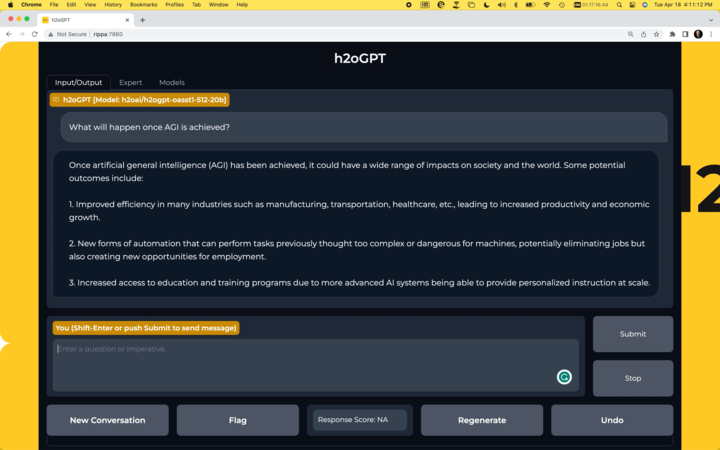
Chatbot
- Run your own chatbot: H2O.ai GitHub
Usage
To use the model with the transformers library on a machine with GPUs, first make sure you have the following libraries installed.
pip install transformers==4.29.2
pip install accelerate==0.19.0
pip install torch==2.0.1
pip install einops==0.6.1
import torch
from transformers import pipeline, AutoTokenizer

tokenizer = AutoTokenizer.from_pretrained("h2oai/h2ogpt-research-oasst1-llama-65b", padding_side="left")
generate_text = pipeline(model="h2oai/h2ogpt-research-oasst1-llama-65b", tokenizer=tokenizer, torch_dtype=torch.bfloat16, trust_remote_code=True, device_map="auto", prompt_type="human_bot")
res = generate_text("Why is drinking water so healthy?", max_new_tokens=100)
print(res[0]["generated_text"])
Alternatively, if you prefer to not use trust_remote_code=True you can download instruct_pipeline.py,
store it alongside your notebook, and construct the pipeline yourself from the loaded model and tokenizer:
import torch
from h2oai_pipeline import H2OTextGenerationPipeline
from transformers import AutoModelForCausalLM, AutoTokenizer

tokenizer = AutoTokenizer.from_pretrained("h2oai/h2ogpt-research-oasst1-llama-65b", padding_side="left")
model = AutoModelForCausalLM.from_pretrained("h2oai/h2ogpt-research-oasst1-llama-65b", torch_dtype=torch.bfloat16, device_map="auto")
generate_text = H2OTextGenerationPipeline(model=model, tokenizer=tokenizer, prompt_type="human_bot")

res = generate_text("Why is drinking water so healthy?", max_new_tokens=100)
print(res[0]["generated_text"])
Model Architecture
LlamaForCausalLM(
  (model): LlamaModel(
    (embed_tokens): Embedding(32000, 8192, padding_idx=31999)
    (layers): ModuleList(
      (0-79): 80 x LlamaDecoderLayer(
        (self_attn): LlamaAttention(
          (q_proj): Linear(in_features=8192, out_features=8192, bias=False)
          (k_proj): Linear(in_features=8192, out_features=8192, bias=False)
          (v_proj): Linear(in_features=8192, out_features=8192, bias=False)
          (o_proj): Linear(in_features=8192, out_features=8192, bias=False)
          (rotary_emb): LlamaRotaryEmbedding()
        )
        (mlp): LlamaMLP(
          (gate_proj): Linear(in_features=8192, out_features=22016, bias=False)
          (down_proj): Linear(in_features=22016, out_features=8192, bias=False)
          (up_proj): Linear(in_features=8192, out_features=22016, bias=False)
          (act_fn): SiLUActivation()
        )
        (input_layernorm): LlamaRMSNorm()
        (post_attention_layernorm): LlamaRMSNorm()
      )
    )
    (norm): LlamaRMSNorm()
  )
  (lm_head): Linear(in_features=8192, out_features=32000, bias=False)
)
Model Configuration
LlamaConfig {
  "_name_or_path": "h2oai/h2ogpt-research-oasst1-llama-65b",
  "architectures": [
    "LlamaForCausalLM"
  ],
  "bos_token_id": 0,
  "custom_pipelines": {
    "text-generation": {
      "impl": "h2oai_pipeline.H2OTextGenerationPipeline",
      "pt": "AutoModelForCausalLM"
    }
  },
  "eos_token_id": 1,
  "hidden_act": "silu",
  "hidden_size": 8192,
  "initializer_range": 0.02,
  "intermediate_size": 22016,
  "max_position_embeddings": 2048,
  "max_sequence_length": 2048,
  "model_type": "llama",
  "num_attention_heads": 64,
  "num_hidden_layers": 80,
  "pad_token_id": -1,
  "rms_norm_eps": 1e-05,
  "tie_word_embeddings": false,
  "torch_dtype": "float16",
  "transformers_version": "4.30.1",
  "use_cache": true,
  "vocab_size": 32000
}
Model Validation
Model validation results using EleutherAI lm-evaluation-harness.
TBD
Disclaimer
Please read this disclaimer carefully before using the large language model provided in this repository. Your use of the model signifies your agreement to the following terms and conditions.
- Biases and Offensiveness: The large language model is trained on a diverse range of internet text data, which may contain biased, racist, offensive, or otherwise inappropriate content. By using this model, you acknowledge and accept that the generated content may sometimes exhibit biases or produce content that is offensive or inappropriate. The developers of this repository do not endorse, support, or promote any such content or viewpoints.
- Limitations: The large language model is an AI-based tool and not a human. It may produce incorrect, nonsensical, or irrelevant responses. It is the user's responsibility to critically evaluate the generated content and use it at their discretion.
- Use at Your Own Risk: Users of this large language model must assume full responsibility for any consequences that may arise from their use of the tool. The developers and contributors of this repository shall not be held liable for any damages, losses, or harm resulting from the use or misuse of the provided model.
- Ethical Considerations: Users are encouraged to use the large language model responsibly and ethically. By using this model, you agree not to use it for purposes that promote hate speech, discrimination, harassment, or any form of illegal or harmful activities.
- Reporting Issues: If you encounter any biased, offensive, or otherwise inappropriate content generated by the large language model, please report it to the repository maintainers through the provided channels. Your feedback will help improve the model and mitigate potential issues.
- Changes to this Disclaimer: The developers of this repository reserve the right to modify or update this disclaimer at any time without prior notice. It is the user's responsibility to periodically review the disclaimer to stay informed about any changes.
By using the large language model provided in this repository, you agree to accept and comply with the terms and conditions outlined in this disclaimer. If you do not agree with any part of this disclaimer, you should refrain from using the model and any content generated by it.